

Table of Contents
- Choosing an Online Lash Course: What Matters Before You Enrol
- Course Overview and Who It Suits
- Lash Training for Beginners: Prerequisites and What You'll Learn
- Lash Course Duration and Study Flexibility
- What an Online Lash Course Costs: Transparent Pricing Breakdown
- Safety, Aftercare and When to Refer a Client
- From Training to Business: Getting Client-Ready
- Frequently Asked Questions
Last Updated: October 8, 2026
Choosing an Online Lash Course: What Matters Before You Enrol
An online lash course is a structured program of video lessons, technique modules and assessments that trains you to apply eyelash extensions, usually completed remotely and at your own pace. At Dear Lash Babe, we have spent over seven years teaching this craft and have mentored more than 2,000 students through it.

Below, we break down what a good course covers, how long it takes, and what you should expect to pay.
Course Overview and Who It Suits
A quality online lash course suits two groups: complete beginners with no beauty background, and working lash artists who want to add volume techniques or sharpen their skills.
If you have never held a pair of isolation tweezers, expect to spend more time on fundamentals: hygiene, eye-area safety, adhesive control and hand positioning.
The format itself is not the problem. A common mistake is treating a self-paced course as a video library to watch once.
Lash Training for Beginners: Prerequisites and What You'll Learn
Most beginner programs assume no prior experience and no formal beauty qualification. You need steady hands, patience, good eyesight or well-fitted magnification, and a space where you can practise without interruption.
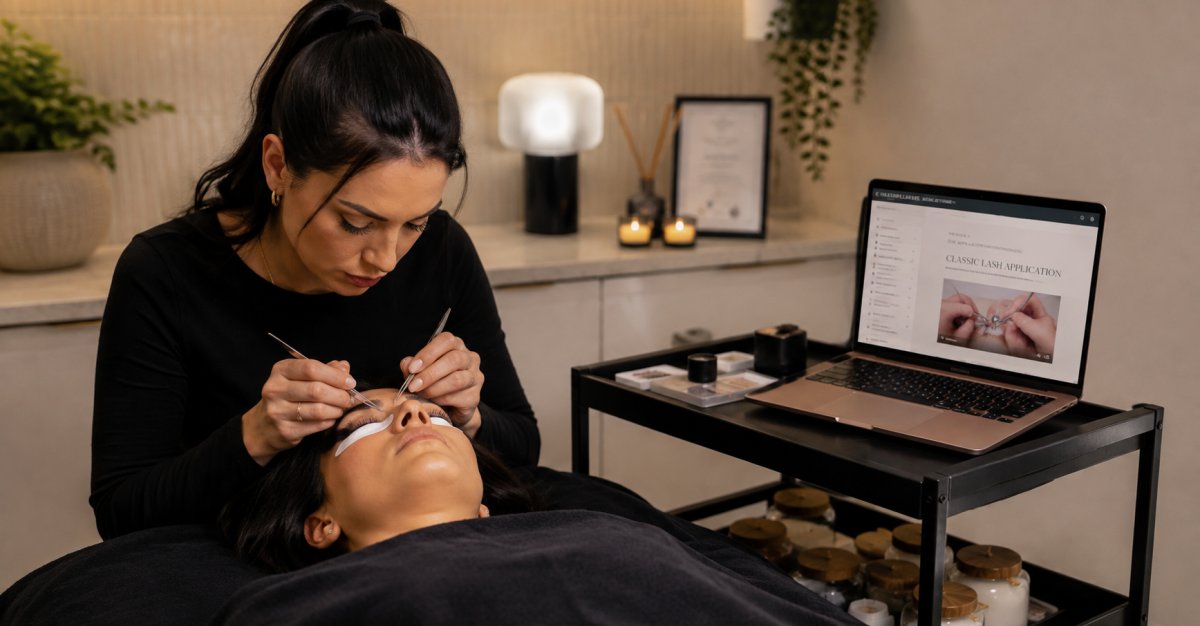
What you learn falls into three layers:
- Fundamentals: isolation, correct adhesive dipping and curing, patch testing, sanitation and safe application
- Technique: classic, volume and hybrid sets, including pre-made volume fans and handmade fans
- Styling: lash mapping for different eye shapes, curl and length selection, and brown lash options for softer looks
Classic, Volume and Hybrid Techniques Covered
Classic lashes apply one extension to one natural lash, which makes them the best starting point for building isolation accuracy. Volume techniques use 2D, 3D and higher fan counts to add density, and many beginners start with pre-made volume fans before moving to handmade fans.
Lash lift and tint is a separate service from extensions and often taught alongside them.
Lash Course Duration and Study Flexibility
Most self-paced online lash courses take four to eight weeks to work through if you study a few hours a week. Reaching genuine competency takes longer, typically two to four months of consistent practice on models, because muscle memory in your fingers builds only through repetition.
Flexibility is where online training wins. You can complete course modules after your kids are asleep, pause between lessons, and revisit tutorials whenever a set goes wrong. What you cannot skip is practice hours.
What an Online Lash Course Costs: Transparent Pricing Breakdown
Most course pages show you one number, the course fee, and stop there. That number is rarely the total cost of getting to your first paying client.
Cost item |
What it covers |
Typical range |
|---|---|---|
Course fee |
Video modules, technique training, assessment, certificate |
$300 - $1,500 |
Starter kit |
Tweezers, lash trays, adhesive, disposables, lash map tools |
$250 - $450 |
Practice models |
Paid or free models for your first 20-40 sets |
$0 - $400 |
Consumables during practice |
Adhesive, remover, cleanser, tape, gel pads |
$80 - $200 over the practice period |
Insurance |
Required before working on paying clients |
Annual premium, varies by cover level |
Ongoing product restock |
Adhesive, lashes, disposables once you are working |
Recurring monthly cost |
The course fee is the headline. The kit, the practice models and the consumables are what actually get you to competency, and they are the costs most providers leave out of their marketing.
Eyelash Extension Course | Online Lash Training →
Bundled Kits vs Buying Separately
Some providers bundle a professional kit into the course fee. Others let you buy the kit separately once you know which tweezers suit your grip.

- Bundled kits spread the cost and guarantee you have the right tools on day one. The trade-off is that you do not choose your tweezers, and a kit built for a beginner may not suit your hand size or grip style.
- Separate kits let you test tweezers before committing. The trade-off is that you may buy the wrong tools first and replace them, which costs more in the long run.
A practical middle path: choose a course that lists the exact kit contents, then price those items individually at a lash supplier. If the bundle is within about 15% of buying separately, the convenience is usually worth it.
What You Are Actually Paying For
Two courses can both cost $650 and deliver very different value. When you compare, look at what sits behind the fee:
- Assessment depth. Is your practical work reviewed by a qualified artist, or is there no assessment at all?
- Feedback format. Written feedback on photos is the minimum. Video feedback or live review sessions are worth more.
- Technique coverage. Classic only, or classic plus volume plus hybrid plus lash lift?
A Reference Point
For context, our Advanced Eyelash Extension Course is $650 and covers classic and advanced volume techniques, lash styling, adhesive control and safe removal, plus business guidance on pricing and client experience.
Add those together and a realistic all-in figure for training plus tools sits around $1,000 before you factor in practice models and insurance. That is the number to compare against other providers, not the course fee alone.
Buying cheap adhesive to save money is a false economy. Poor adhesive forces you to work slower, causes more stickies and drives clients away with premature shedding. Train with the products you intend to use on real clients.
Ask any provider for a full cost breakdown before you enrol, course fee, kit contents, assessment fees, and whether consumables are included. A provider that will not itemise is a provider that is hiding something.
Safety, Aftercare and When to Refer a Client
Safe application starts before the first extension goes on.
Aftercare decides whether your work lasts. Clients should keep lashes dry for the first 24 hours, avoid oil-based products around the eyes, and brush daily with a clean spoolie.
Know when to stop and refer. Redness, swelling, itching, discharge or any sign of infection means the client sees a doctor, not you.
A certificate proves you completed training. Safe, repeatable technique and honest referral boundaries are what keep your business running.
From Training to Business: Getting Client-Ready
Finishing the course is the halfway point. The other half is turning technique into a client base, and it is where most new lash artists stall.
Start with pricing. Work out your cost per set, including product, your time and your overheads, then set a price that lets you profit at a realistic booking rate.
Then build the boring systems: a consultation form, a patch test record, an aftercare sheet and a booking process.
For artists already lashing part-time, the ceiling is usually business knowledge, not technique. Our Lash Educator Online Course ($1,450) is built for artists ready to teach and mentor others, and it covers structuring training, assessing students and running workshops.

Frequently Asked Questions
Can you learn eyelash extensions entirely online?
Yes, an online lash course can take you from zero to competent if it includes step-by-step video modules, downloadable guides and assessment. You will still need to practise on models or mannequin heads to build hand stability and speed. Look for a course that covers isolation, lash mapping, adhesive control and safe removal, plus offers student support when you get stuck. Practical, repeated practice is what converts video lessons into real skill.
How long does it take to complete an online lash course?
Most self-paced online lash courses take anywhere from a few weeks to a few months, depending on how much time you can commit each week. Lash course duration is less about the calendar and more about how many hours you put into practice. Beginners typically need 20 to 40 hours of hands-on practice after finishing the modules to feel confident. Courses with lifetime access let you revisit lessons as your technique develops.
What qualifications do I need to become a lash technician?
You do not need prior beauty qualifications to start lash training for beginners. What matters is completing a structured course that covers classic, volume and hybrid techniques, hygiene and safe application, and then earning a certificate of completion. Lash technician qualifications vary by provider, so check what the certificate covers and whether it includes assessment. Some insurers and councils may ask for evidence of training when you set up your business.
Does an online lash course include practical assessment?
Quality online lash courses include assessment, not just video watching. This can take the form of photo submissions of your work, quizzes, or live video check-ins with an educator. Assessment is what separates a course you actually finish from one you watch once and forget. Before enrolling, ask how many assessments are included, who marks them, and how quickly you get feedback. That feedback loop is where real improvement happens.
Lash training rewards people who practise deliberately, not people with natural talent. If you want structured modules, real mentorship and lifetime access so you can revisit lessons as your skills grow, Dear Lash Babe is built for exactly that. Our courses include step-by-step training, assessment-based certification, ongoing educator support and a community of artists working toward the same goals. Get started with Dear Lash Babe and build a lash career you can sustain.