

Table of Contents
- What Earning Six Figures Actually Means for a Lash Artist
- Lash Extension Pricing: The Number That Decides Everything
- Client Capacity: How Many Appointments Fit in a Week
- Lash Business Expenses: Where the Revenue Actually Goes
- How to Grow a Lash Business Without Burning Out
- Retention: Why Repeat Clients Beat Constant New Bookings
- Lash Business Marketing That Fills the Books
- Employee, Booth Renter or Studio Owner: How the Structure Changes Your Take-Home Pay
- The Realities Nobody Mentions: Slow Weeks, Cancellations and Ongoing Training
- Conclusion: Is Six Figures Realistic for a Lash Artist?
- Frequently Asked Questions
Last Updated: October 10, 2026
What Earning Six Figures Actually Means for a Lash Artist
Can lash artists earn six figures? Yes, but to earn six figures the number that matters is not the one on your booking app. It is the one left after expenses, tax and product costs. Six figures in revenue and six figures in take-home pay are two very different achievements, and most guides blur them together.
At Dear Lash Babe, we have mentored more than 2,000 students, and the same question comes up again and again: "I'm stuck at $2k a month. Is six figures real?" It is real, but it is a business outcome, not a talent outcome.
Here is the distinction that changes everything:
- Gross revenue is every dollar clients pay you.
- Net income is what remains after expenses and tax.
- Take-home pay is what actually lands in your account.
A lash artist turning over $100,000 in bookings might keep far less once supplies, rent, insurance, software and tax come out. The Australian Taxation Office treats you as a business, not an employee, so you carry those costs yourself. You can review the ATO guidance for sole traders to see what that involves.

Below, we break down the real numbers, the capacity maths, and the staged plan that gets you there.
Lash Extension Pricing: The Number That Decides Everything
Lash extension pricing is the single biggest lever on your income. Charge too little and no amount of hard work will close the gap.
A full set at $80 with a refill at $50 means you need enormous volume to hit six figures. A full set at $180 with a refill at $90 gets you there with a fraction of the clients.
Why the Cheapest Artist on the Street Usually Earns the Least
Discount pricing creates a trap. Cheap clients are the most likely to cancel, haggle and disappear after one appointment. They also cost the same in product and time as premium clients.
Worse, cheap pricing often signals inexperience. Clients shopping for eyelash extensions usually equate low prices with higher risk to their natural lashes.
What most guides miss is that pricing is a positioning decision, not a maths problem. Raise your prices when your retention is strong, your photos are clean, and your books are full.
Client Capacity: How Many Appointments Fit in a Week
Client capacity sets your income ceiling, and most guides treat that ceiling as a simple headcount. It is not. Capacity is a function of service duration, refill cycles, admin time and the cancellations you will inevitably absorb.
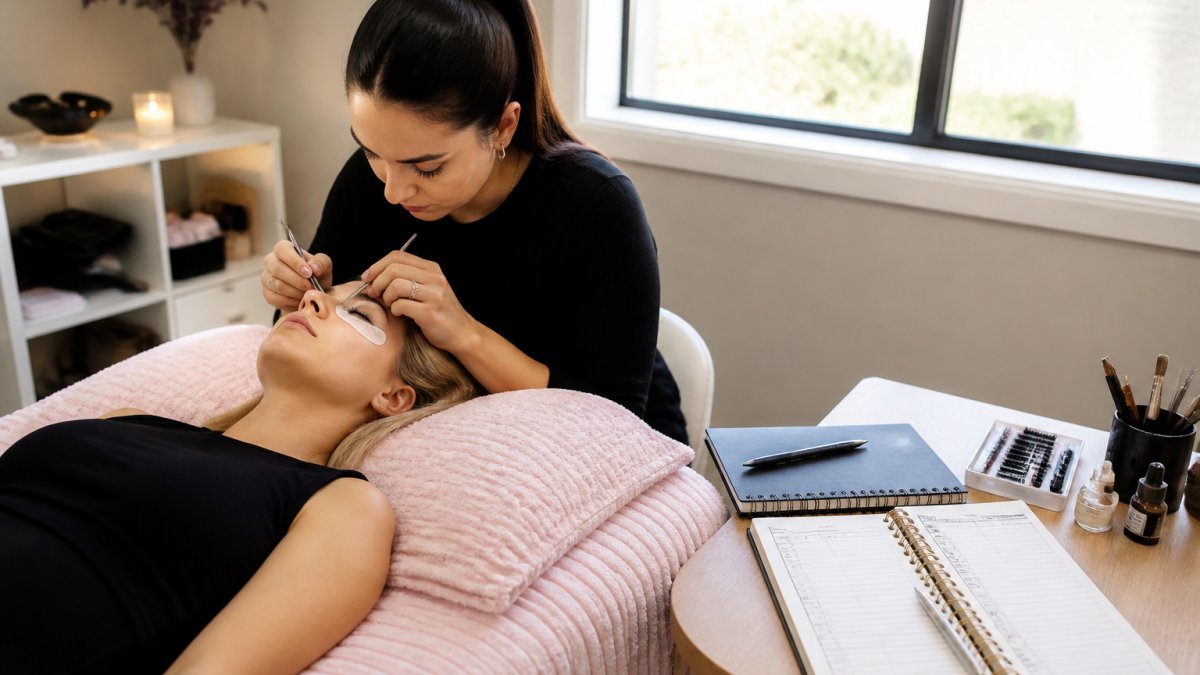
Start with the clock. A full set commonly runs two to three hours, and a refill 60 to 90 minutes. If you work a five-day week at roughly seven hands-on hours a day, that is about 35 treatment hours. At an average of two hours per appointment, that is a theoretical maximum of around 17 appointments. Push to 20 and you are relying on shorter refills and no gaps between clients, which rarely survives contact with real life.
The Hours That Do Not Earn
Every booked hour carries unpaid overhead. A realistic week includes:
- Consultations and patch tests before a first full set
- Setup and sterilisation between clients
- Admin, messages, deposits, rescheduling, reminders
- Content, photographing sets and editing for social proof
- Stock and ordering, adhesive rotation, tray inventory
A common pattern is one to two unpaid hours for every five hands-on hours. That is the difference between a 20-appointment week and a 20-appointment week you can actually sustain.
Model It Before You Commit
Say you average $100 per appointment across a mix of full sets and refills. Twenty clients a week over 48 working weeks produces $96,000 in gross annual revenue, before a single expense.
Weekly Clients |
Average Appointment |
Working Weeks |
Gross Annual Revenue |
|---|---|---|---|
15 |
$100 |
48 |
$72,000 |
20 |
$100 |
48 |
$96,000 |
20 |
$130 |
48 |
$124,800 |
25 |
$130 |
46 |
$149,500 |
Notice something. Going from 20 clients at $100 to 20 clients at $130 adds more than $28,000 without a single extra appointment. Capacity is finite. Price is not.
The Cancellation Reality
No-shows and late cancellations are not an edge case, they are a line item. A deposit policy and a clear cancellation window protect the slot, but even disciplined artists typically lose a percentage of booked hours each month to illness, school holidays and last-minute changes. Build a buffer into your model rather than assuming every slot converts.
From Gross to Net
This is the step most capacity guides skip. Gross revenue is not take-home pay. From that $96,000 you still subtract product, rent or booth fees, insurance, software, card processing, marketing and tax. The Australian Taxation Office treats you as a business, so those costs sit with you. The ATO guidance for sole traders sets out what that involves.
A practical rule of thumb many artists use is to model net income at roughly half of gross revenue once all costs and tax are accounted for, but the exact figure depends on your rent, your product spend and your structure. Run your own numbers rather than borrowing someone else's ratio.
Lash Business Expenses: Where the Revenue Actually Goes
Lash business expenses are what separate a busy artist from a profitable one. Revenue pays for your supplies, your space and your tax bill before it pays you.

Common ongoing costs include:
- Lash trays, adhesive, tweezers, tape and aftercare products
- Rent, booth fees or a home studio setup
- Insurance and professional memberships
- Booking software and card processing fees
- Marketing, content and paid ads
- Ongoing training and refreshers
Startup Costs Versus Ongoing Costs
Startup costs hit once. Ongoing costs hit every month, and they scale with how many clients you see.
A common mistake is spending heavily on branding and equipment before the bookings exist. Build the client base first, then reinvest.
How to Grow a Lash Business Without Burning Out
Growing a lash business is about raising your average appointment value and protecting your body, not adding more hours. More hours eventually break your hands, your posture and your retention.
What most guides miss is that growth is staged. The levers that work for a beginner are not the levers that work for an established solo artist, and neither is the lever that works for a studio owner. Here is a realistic progression.
Stage 1, Beginner (Months 0-12): Build the Book
At this stage your job is repetition and retention, not revenue. Focus on:
- Filling a consistent three to four days a week
- Getting refill clients to rebook before they leave
- Photographing every set for social proof
- Learning your true service duration so you can schedule honestly
A realistic milestone is a book that stays roughly 70-80% full for three consecutive months. Do not raise prices aggressively until retention is stable, churn at this stage costs more than a price rise earns.
The Lash Business Launch Strategy™ →
Stage 2, Established Solo Artist (Months 12-36): Raise the Average Ticket
Once your book is reliably full, growth comes from price and mix, not volume. Levers that work here:
- Move suitable clients from classic to volume sets where their natural lashes allow
- Add a premium tier with a longer appointment and a higher price
- Introduce retail aftercare products at checkout
- Tighten scheduling to reduce gaps between appointments
- Raise refill prices gradually rather than in one jump
This is the stage where most artists cross into six-figure gross revenue, not by seeing more clients, but by earning more per client. A $30 average-ticket increase across 20 weekly appointments adds more than $28,000 a year without a single extra hour.
Stage 3, Growing Studio (Year 3+): Add Revenue Beyond Your Hands
Your hands are the ceiling. To grow past it, you add income streams that do not require you to be the one lashing:
- Training and education for newer artists, where you are appropriately qualified
- Complementary services you are trained to deliver
- A second chair or team member, which introduces wages, super and rostering obligations
- Retail and product partnerships
Each of these adds complexity, payroll, insurance, workplace obligations. The Australian Government business guidance is a sensible starting point before you take on staff.
Protect the Asset
The artists who scale are the ones who protect their hands and their energy. Burnout costs you weeks of income, and rebuilding a full book takes months. Practical protections:
- Cap hands-on hours per day rather than chasing a client count
- Invest in a proper chair, lighting and magnification
- Take scheduled breaks between clients, not just when a gap appears
- Budget for at least one training update annually so your technique stays current
A Note on Timelines
Most artists who reach six figures do so gradually, over two to four years, with steady price rises and a book that stays full. Anyone promising a faster path is usually selling something. The staged approach above is slower to describe and faster to survive.
Retention: Why Repeat Clients Beat Constant New Bookings
Client retention is the cheapest growth strategy in the industry. A repeat client costs nothing to acquire and books predictably.
Quality application drives retention more than any discount. If lashes shed early, clients do not blame the glue. They blame you.
Support retention with:
- A proper consultation before the first set
- Clear aftercare education at every appointment
- Consistent results across visits
- Reliable refill reminders
- Honest advice about lash health
Repeat clients also refer. Word of mouth remains one of the strongest sources of new business in the beauty industry, as noted in broader IBISWorld research on personal services coverage of the sector.
Lash Business Marketing That Fills the Books
Lash business marketing works best when it targets a specific client, not everyone. Broad appeal produces broad indifference.
Focus on three things:
- Google visibility so people searching for lash extensions nearby find you
- Social proof through consistent before-and-after content
- Reviews that build trust before a client ever messages you
A practical system beats random posting. Plan content monthly, batch your photos, and keep your booking link in every bio.
Employee, Booth Renter or Studio Owner: How the Structure Changes Your Take-Home Pay
Your business structure changes your take-home pay more than most artists realise. The same weekly revenue produces very different outcomes depending on how you work.
Structure |
What You Pay |
What You Keep |
Best For |
|---|---|---|---|
Salon employee |
Nothing upfront |
Wages or commission |
Learning with steady income |
Booth renter |
Fixed weekly rent |
All service revenue |
Established client base |
Studio owner |
Rent, bills, staff |
Profit after overheads |
Scaling beyond your own hands |
Self-employed artists carry more risk but keep more per appointment. Employees trade upside for stability and paid leave.
If you are unsure, start employed or renting. Move to ownership once your books stay full for several months.
The Realities Nobody Mentions: Slow Weeks, Cancellations and Ongoing Training
Every lash business has slow weeks. January can be quiet, and school holidays shift booking patterns. Cancellations and no-shows will happen no matter how good you are.
Plan for it:
- Hold a buffer for two slow months a year
- Use a cancellation policy with a clear deposit
- Keep learning, because techniques and products change
- Budget for at least one training update annually
The Australian Government business guidance is a useful starting point for setting up your structure, registrations and tax obligations properly.
Conclusion: Is Six Figures Realistic for a Lash Artist?
Six figures is realistic, but it is a business result, not a talent result. It comes from sustainable pricing, controlled capacity, low client churn and disciplined expense management.
Most artists who reach it do so gradually, over two to four years, with steady price rises and a book that stays full.
If you want the technical skill and the business systems together, Dear Lash Babe teaches both. Our courses include lifetime access, real mentorship and ongoing support, plus business education built around scaling and income creation. You graduate with a certificate of completion and the confidence to lash like a professional.
Get started with Dear Lash Babe and build a lash business that pays you properly.
Frequently Asked Questions
How much do lash techs make in Australia?
Earnings vary widely by pricing, client volume and business structure. A part-time lash artist doing a handful of appointments a week might gross a few hundred dollars weekly, while a full-time artist with a full book and premium pricing can gross well over $100,000 a year. What matters is take-home pay after expenses, not the headline revenue figure.
Can a lash artist earn $100,000 a year?
Yes, but it takes more than good technique. You need pricing that covers your costs, a booking rate close to full capacity, strong client retention and controlled expenses. Many artists reach six figures in gross revenue and far less in profit, so track your net income monthly rather than celebrating the top-line number.
How many clients does a lash artist need to make $100,000?
At an average appointment value of $100, you need roughly 1,000 appointments a year, which is about 20 clients per week over 48 working weeks. That produces around $96,000 in gross revenue before expenses. Raise your average appointment value with add-on services or premium sets and you need fewer bookings to hit the same figure.
Is doing lashes a good side hustle?
It can be, because appointments fit around a day job and you control your hours. The catch is that part-time hours limit your income ceiling, and you still carry supply, insurance and marketing costs. Treat it as a business from day one, track every expense and reinvest slowly as your client base grows.